





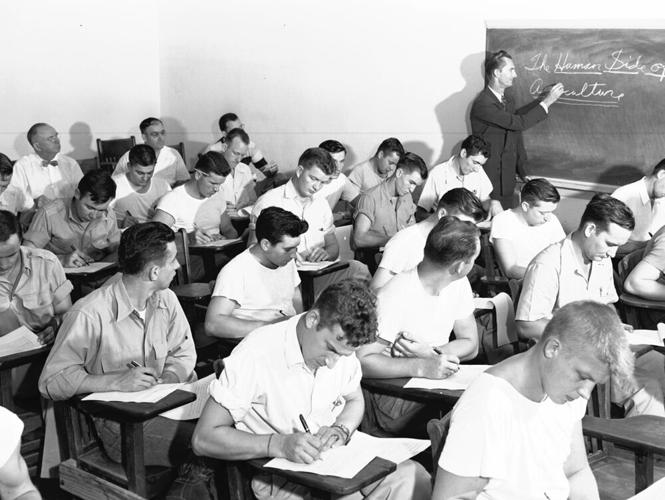




“What we do today is the same thing we’ve been doing for 150 years. It may look a little different, but it’s the same,” said Dr. Jeffrey Savell ’75, vice chancellor and dean for agriculture and life sciences at Texas A&M. “We are in the life-transformation business. I had a professor who pushed me toward things I would not have tried on my own, and it changed the course of my life. Fifty years later, I can tell you I was not the exception. It happens here every day.”
For Dr. Robert Bishop ’79, vice chancellor and dean of Texas A&M Engineering, that transformation began with an opportunity he remains grateful for to this day.
“I am from a modest family, and no one in my family finished college prior to me. I was a good student in high school, but I really wasn’t the highest-ranking kind of student. I got accepted to Texas A&M, I believe, because of its mission. And I was given an Opportunity Award, which paid for my school,” Bishop reflected. “That’s part of the land-grant mission. These things aren’t natural for many universities, but I think for the land grant, the mission is critically important. Part of its beauty is that while we are excellent and have outstanding students and faculty, we also reach out to people who otherwise might not have an opportunity for an education at the level that we provide.”
People are also reading…
Bishop’s experience reflects a central tenet of the land-grant mission: Practical higher education should be accessible to the broader public. Today, Texas A&M continues to uphold that principle, even as the rising cost of higher education threatens to put a college degree out of reach for many families.
Despite nearly universal increases in higher education costs nationwide, Texas A&M has not increased undergraduate tuition since 2021 and has extended its tuition freeze through academic year 2026-27. The university also provides more than $1.1 billion in aid annually and recently expanded the Aggie Assurance program, making even more low- and middle-income Texas families eligible for scholarships and grants that cover all required tuition and fees for a student pursuing an undergraduate degree. Through this program, qualifying students and their families do not pay any required tuition and fees out of pocket.
These and other impactful efforts — including a previous initiative to keep textbook costs low — are helping more Aggies finish college without the burden of substantial student debt. Today, 63% of Texas A&M students graduate debt-free, which is well above the national average of 45%.
“Affordability and return on investment have been focal points for universities — and their critics — for a long time,” said Chris Reed, Texas A&M’s associate vice president for enrollment management and chief enrollment officer. “Texas A&M’s outcomes are strong, and we’re determined to make sure affordability remains an equal priority. Extending the tuition freeze and expanding Aggie Assurance are two concrete ways we’re keeping a Texas A&M degree attainable for more students and families.”


