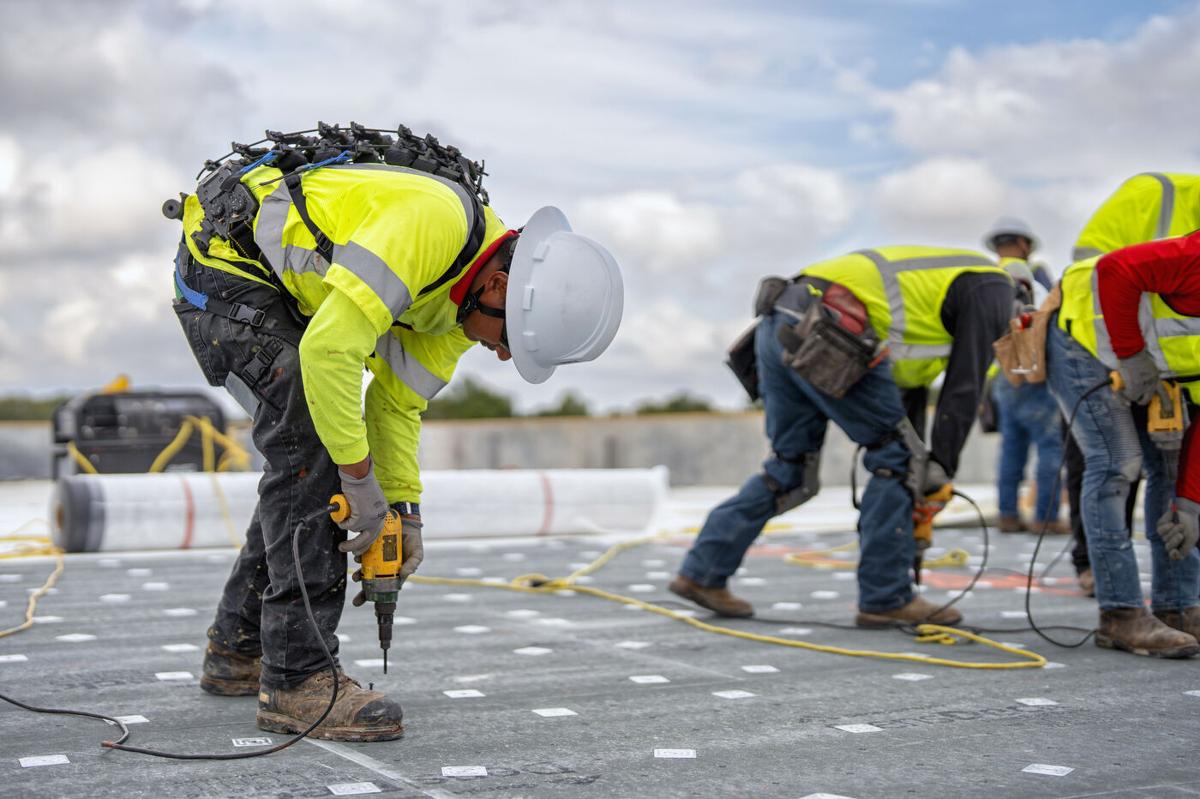
Taking some of the physical strain off construction workers could do more than reduce fatigue. New research from Texas A&M University suggests it may also help them recognize hazards around them.
In a field study of 16 construction workers, researchers found that workers using a passive lower-back exoskeleton experienced 37% less fatigue and improved their hazard recognition performance by 29%. The findings point to a connection between reducing physical fatigue and helping workers remain attentive to potential dangers on the job site.
“Construction safety involves both your body and your mind,” said lead author Prosper Gbiengu, a graduate research assistant and doctoral student in the Department of Construction Science. “If you reduce fatigue, that helps keep the worker more attentive, and you’re able to identify more hazards.”
The study, published in ASCE Open: Multidisciplinary Journal of Civil Engineering, adds a new dimension to research on wearable exoskeletons, which has largely focused on their ability to reduce strain.
People are also reading…
Testing exoskeletons in the field
Exoskeletons can support different parts of the body, including the arms, back and knees. The model used in the field study was a prototype passive lower-back exoskeleton designed to reduce the effort required during physically demanding work.
Chukwuma Nnaji, associate professor in the Department of Construction Science, said exoskeletons remain relatively uncommon on construction sites but are more commonly used in structured workplaces such as automobile manufacturing, logistics and warehousing, where workers are more likely to repeat the same movements. Construction presents a more complicated challenge.
“You will rarely find a company that is fully deploying exoskeletons,” Nnaji said. “In construction, we tend to be more dynamic — moving from one subtask to another to complete one larger task, so the movements tend to be different.”
To examine how the technology performs under those conditions, construction workers completed three-hour sessions performing their normal work both with and without an exoskeleton. Researchers measured their fatigue and showed them images of construction hazards before and after each session, asking them to identify the hazards and assess the associated risks.
In addition to workers being less fatigued and better at recognizing hazards while using the exoskeleton, the researchers also found that workers who experienced smaller increases in fatigue tended to show greater improvements in hazard recognition. This suggests a connection between workers’ physical state and their safety-related cognitive performance.
Nnaji said the findings add another layer to the evidence that exoskeletons can reduce workers’ physical exertion: If workers are less fatigued, they may have more cognitive resources available to focus on what is happening around them.
“If you’re able to focus on the task because you’re less fatigued, then you’re better able to detect things that might be anomalies in your environment,” he said.
That can be particularly important in construction, where workers must continually recognize and respond to changing conditions around them.
“For us in construction, that is foundational because our environment is extremely dynamic,” Nnaji said. “It’s changing often, and you need to be aware of what’s going on around you.”
Managing fatigue on the job site
For construction companies, the findings suggest that managing physical fatigue may have implications beyond reducing strain on workers’ bodies. Nnaji cautioned, however, against viewing exoskeletons as a universal solution. “Exoskeletons are not a silver bullet,” he said.
Instead, Nnaji said companies should first look for opportunities to eliminate or reduce risks through the way work is designed. When physical demands cannot be eliminated, technologies such as exoskeletons may provide another way to reduce the amount of exertion required from workers.
The research team is continuing to test exoskeletons on job sites and work with industry partners to better understand how the devices can be designed and used safely for construction work. Nnaji said collaboration with workers is critical to developing technology that addresses the realities of construction rather than problems defined solely in a laboratory.
“If you design solutions in a vacuum, you will not be able to solve the real problem,” Nnaji said. “You need to engage with people. You need to be on the job site. You need to see how jobs are being executed.”