


(WACO, Texas) – As students return to Texas classrooms and athletic fields, many are facing their share of 100 degree days.
The National Weather Service (opens in new tab) in Fort Worth has indicated temperatures will stay in the upper 90s and lower 100s through the next week, with the heat index continuing to rise into the triple digits. September will greet Texans with a lot of the same weather. The National Weather Service’s Climate Prediction Center (opens in new tab) has predicted slightly above-normal temperatures throughout the fall.
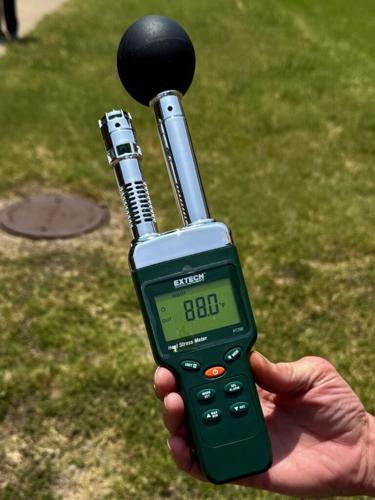
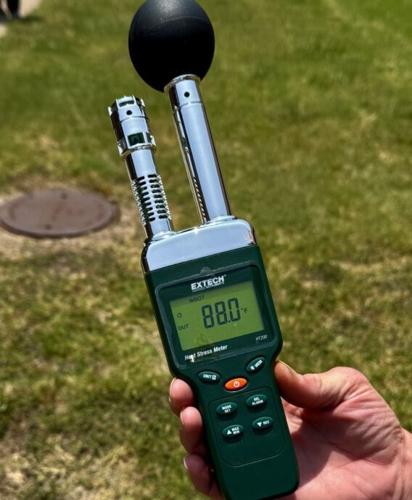
For athletic personnel across the state, they are adapting to updated guidelines from the University Interscholastic League (UIL) (opens in new tab): Starting this year, the use of wet-bulb globe temperature meters is required for use in outdoor activities. The organization mandates the readings need to be taken within 15 minutes of an activity starting. The UIL recommends the same person be designated to collect data throughout outdoor sessions.
People are also reading…
The people who are learning about wet-bulb globe temperature meters are students in Texas State Technical College’s Occupational Safety and Environmental Compliance (OSEC) program. During a recent Industrial Hygiene class at the Waco campus, students learned the meters were invented in the 1950s for use at military training camps and how they operate in the shade versus on pavement.
“We normally train to watch out for each other to recognize and to intercede at any time they see someone struggling,” said Patti Tate, an instructor in TSTC’s OSEC program.
Tate said working outside is best done first thing in the morning when it is projected to be not as hot.
“In this heat, later than that it is really necessary to stop, rest, and cool down,” she said. “Afternoon is the hottest time of the day. Evenings, when the sun is going down, would be another avenue to do work, but with caution.”
Lindsay Sanders, a Vocational Nursing instructor at TSTC’s Sweetwater campus, said common sense when outdoors should be used by everyone.
“The most important thing is to remain hydrated. In these temperatures, the more you drink, the better off you will be,” she said.
Fall outdoor sports currently taking place for Texas schools are cross country, football, golf and tennis. Marching bands, cheerleaders and dance teams also practice and perform throughout the autumn.
Julianna Flores, an athletics trainer at Waco High School (opens in new tab), said the seniors typically know their bodies and how to prepare.
“There is always a little concern for the freshmen because we do not know them because they are coming from middle school to high school,” she said.
Flores said it is important to know a student’s medical history, and whether they have risk factors such as diabetes. She said the athletics staff also needs to know if students have had heat exhaustion in the past.
“The coaches are really good about being aware of what is going on and taking kids’ requests seriously,” she said.
Flores said she and coaches can sense when students did not put as much effort in during the summer as they should have.
“The problem seems to be right now a kid not showing up for summer workouts,” she said. “They are coming into fall struggling a little bit. But the kids are not fully grasping how important nutrition and hydration is. The first week is always kids feeling a little sick or tired.”
Flores said all training staff have access to electrolytes and pickle juice shots when they are required.
Brynna Seay is in her third year of athletic training at University High School (opens in new tab) in Waco. She said students are advised when they leave school in the spring to practice hydration and stay committed throughout the summer.
“The first couple of days are the most intense because they are most at high risk,” she said. “We have some athletes doing things during the summer, but for a handful, it is their first day.”
Seay said communication with the coaching staff is important to determine whether to shorten or delay practices. Athletics trainers collect wet-bulb temperature information to share with coaches.
Seay said Waco ISD Stadium has hoses on both sides on each sideline along with a portable cold and ice tub.
Sanders said one of the common ailments in extreme heat is exhaustion.
“If you or someone you see is suffering from heat exhaustion, get them in the shade immediately. They need to cool down,” she said, noting that cold water or ice packs will speed up the cooling process.
Sanders said attire is also important.
“Loose-fitting clothing for many outdoor activities is best,” she said.
Tate said the heat can affect people differently.
“If someone is overweight or not physically fit, the body has to work harder to cope with the heat,” she said. “The body has to acclimate and develop stamina to deal with heat. It is important to have a trained staff to recognize heat-related signs and symptoms.”
Tate and her fellow instructors teach these safety protocols in TSTC’s OSEC program to ensure graduates are equipped to protect crews in high-risk environments.
The fall semester starts at TSTC on Tuesday, Sept. 8.


