
On active road construction sites, warning alarms, passing traffic and moving equipment are a constant presence throughout the workday. Over time, those sights and sounds can begin to fade into the background.
When workers encounter the same hazards day after day, they can become desensitized, said Dr. Namgyun Kim, an assistant professor in the Department of Construction Science at Texas A&M University. Workers may begin to tune out the flashing warnings and beeping alarms to focus on the task at hand.
"That is the moment that accidents happen," said Kim, a leading researcher focused on improving construction safety and productivity through virtual reality, augmented reality and artificial intelligence.
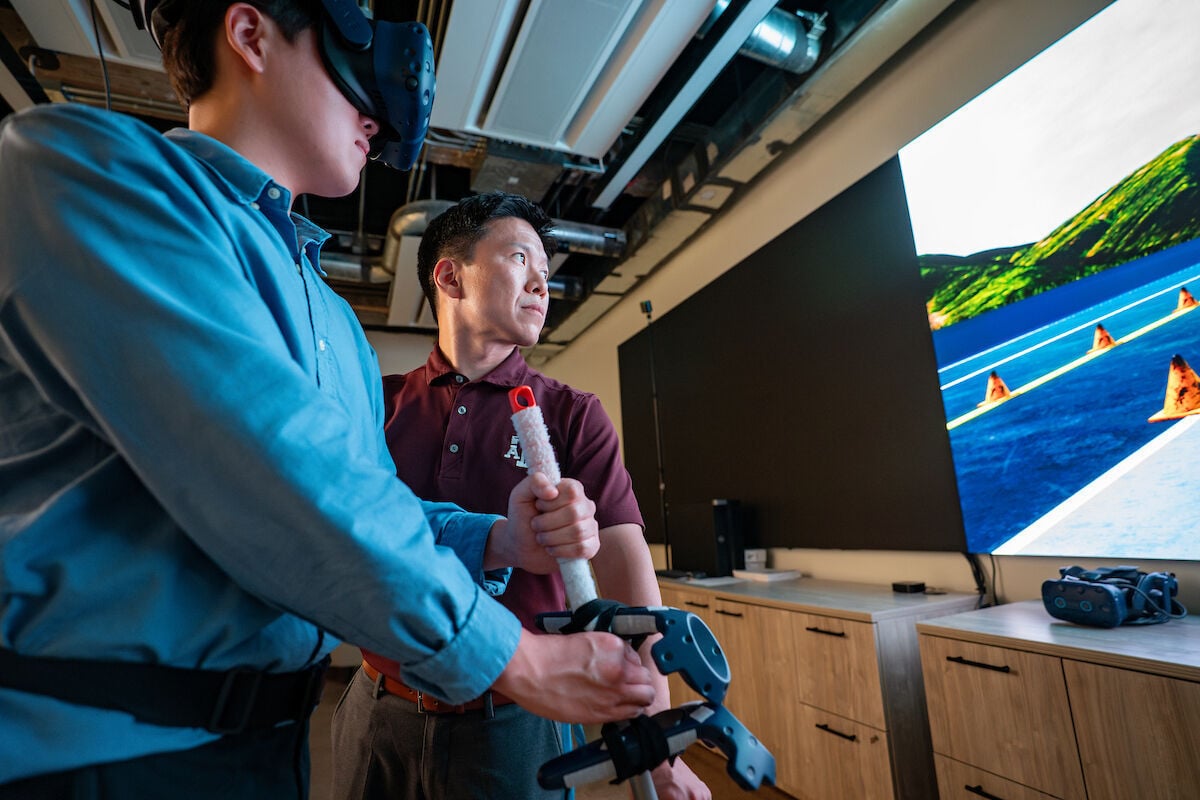
At his Safety Systems.AI Lab, Kim collaborates with Dr. Brian Anderson, who leads the Learning and Attention Lab, to study how workers perceive and respond to hazards using these advanced technologies to develop systems to improve workplace safety and reduce injuries. Through a series of studies involving virtual reality simulations, brain activity monitoring, field observations and AI-driven augmented reality systems, Kim’s work examines whether immersive, experience-based training can help workers maintain attention to hazards in both controlled environments and active work zones.
People are also reading…
The issue is particularly significant in roadway construction. From 2011 to 2021, struck-by incidents — when a person is hit by a vehicle, piece of equipment or other object — accounted for about 1,800 fatal injuries and more than 167,000 nonfatal injuries, according to the National Institute for Occupational Safety and Health (NIOSH).
Simulating accidents to restore attention
To tackle this issue, Kim’s research is exploring if immersive experiences could improve workers’ attentiveness to hazards.
In one study, Kim’s lab developed a virtual road construction environment where workers performed routine tasks while exposed to warning alarms and nearby equipment. The findings were reported in a 2021 study published in the Journal of Construction Engineering and Management.
Using eye-tracking technologies, researchers measured whether workers noticed surrounding hazards. If they failed to respond to a warning signal, the system triggered a simulated accident.
One scenario re-created the type of struck-by incidents that occur on real roadway projects. Although equipment was moving at relatively slow speeds, workers often remained focused on their assigned task rather than nearby hazards — illustrating how repeated exposure can reduce attentiveness over time.
The studies found that workers became more attentive after experiencing the virtual event. But Kim wanted to understand whether the changes extended beyond observable behavior.
In more recent work, Kim and his collaborators used EEG sensors, which measure electrical activity in the brain, to compare the reactions of construction workers with people who had no construction experience. They found that while construction workers continued to detect warning alarms at a basic sensory level, repeated exposure appeared to reduce the attention their brains devoted to processing those sounds as warning signals. In other words, workers could still hear the alarms, but they were less likely to cognitively engage with them.
From the lab to the field
Kim said a common challenge in safety research is determining whether improvements observed in a training environment translate to real-world behavior. To answer that question, he expanded the research beyond the laboratory and into active highway work zones.
Workers completed a virtual training and then returned to the field, where researchers monitored their behavior around live traffic. After the training, workers demonstrated increased vigilance, including spending more time looking toward approaching vehicles and traffic while performing roadway maintenance tasks.
"Now we can say it is effective in the real-world behavior change," Kim said.
The findings suggest immersive simulations may provide a safe way to expose workers to the consequences of inattentiveness before an accident occurs.
Bringing training directly to the jobsite
While virtual reality can create highly immersive training experiences, Kim said widespread adoption remains difficult on large construction projects.
Kim is developing an AI-powered augmented reality system designed to provide safety training within a worker’s actual jobsite environment. Workers take a photo of their work area, and an AI model identifies potential hazards before generating site-specific safety scenarios through an augmented reality interface.
For example, if the system detects an unprotected opening or another fall hazard, it can generate an augmented reality accident simulation directly within the worker’s real-world surroundings. Rather than relying on generic safety examples, the training is tailored to the conditions workers are likely to encounter that day.