


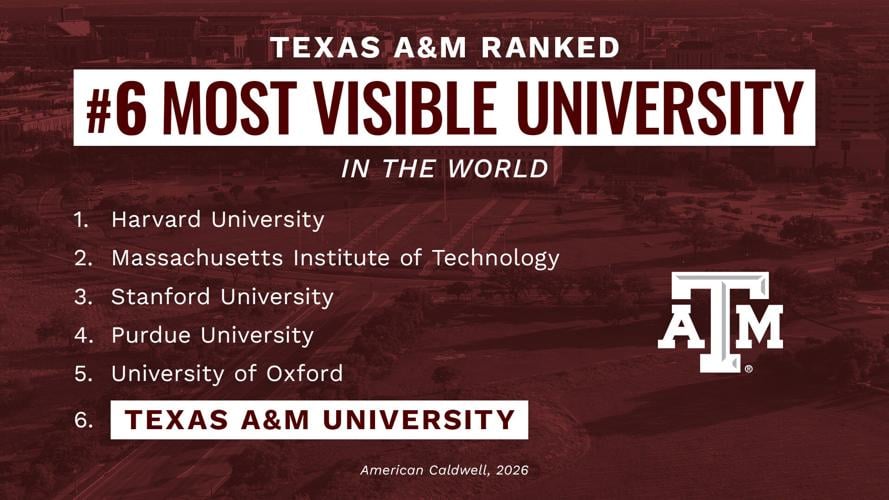
Texas A&M University ranks No. 6 in the world in American Caldwell’s latest Global University Visibility Rankings, placing the institution among the world’s most visible universities.
Texas A&M ranks No. 5 among all U.S. universities, No. 2 among U.S. public universities and No. 1 overall in Texas in the 2026–2027 rankings, making it one of the world’s most talked about, searched, visited, followed and watched institutions of higher education.
The university’s two-year trajectory is notable. Since 2024, Texas A&M has moved from No. 21 to No. 6 globally, a gain of 15 spots; from No. 14 to No. 5 among U.S. universities, a gain of nine spots; and from No. 3 to No. 2 among U.S. public universities. Texas A&M has now held the No. 2 public university position for two consecutive years and has been the most visible university in Texas for at least three consecutive rankings.
People are also reading…
American Caldwell, a higher education market research firm, noted that Texas A&M “increased its visibility considerably,” citing significant increases in news mentions and video views. The top of the 2026–2027 rankings is led by Harvard University, Massachusetts Institute of Technology, Stanford University, Purdue University and Oxford University, with Texas A&M following at No. 6. The ranking places the university in increasingly rare company, immediately behind some of the world’s most visible higher education brands and ahead of Arizona State University, Cornell University, the University of California-Berkeley and UCLA.
The Global University Visibility Rankings measure university brand visibility over a 12-month period using publicly available third-party data. The methodology includes news mentions, public interest through search activity, social media following, website visitors, web references, online footprint and video views. American Caldwell does not rely on university self-reporting.
“Texas A&M University’s increased visibility reflects more than institutional promotion. It reflects growing national and global interest in the Aggie story,” said R. Ethan Braden, vice president and chief marketing and communications officer at Texas A&M. “People are searching for Texas A&M, reading and watching our stories, visiting our channels and encountering our work in the news. That creates a larger opportunity, and a larger responsibility, to help people understand who we are, what we stand for, how we serve as a force for good and why Texas A&M matters to Texas, the nation and the world.”
The university’s progress follows several years of increased national storytelling, expanded earned media, stronger digital engagement, growing video reach and strategic efforts tied to research, service, values and national relevance.
“News mentions were a driver of Texas A&M’s movement in this year’s rankings, and earned media remains one of the strongest signals of relevance,” said Tim Doty, associate vice president for earned media at Texas A&M. “Much of that visibility begins with our faculty and research experts, whose work helps explain, solve and give context to issues people care about. When Texas A&M experts appear in news stories about research, discovery, national security, agriculture, health, engineering, service and the future of Texas, audiences see the university not only as large or well known, but as useful, relevant and necessary to the conversations shaping our state and country.”
In 2024, Texas A&M was named the most visible university in Texas and ranked No. 21 globally. In 2025, the university moved to No. 13 worldwide, No. 8 among U.S. universities and No. 2 among U.S. public universities.
As Texas A&M approaches its 150th anniversary, its continued momentum in global visibility underscores a larger opportunity: to convert attention into understanding, understanding into trust and trust into even greater demand and impact.


