


Every year, thousands of parrots confiscated from the illegal wildlife trade arrive at rehabilitation centers across Latin America. For many of these birds, rescue centers can provide safety but not necessarily a path back to the wild.
While rehabilitation centers work to care for surrendered and confiscated animals, successful release can be difficult. Some birds struggle to find food, navigate unfamiliar landscapes, avoid predators or resist approaching people after spending months or years in captivity. Others never leave rehabilitation centers at all.
Now, new research from the Texas A&M College of Veterinary Medicine and Biomedical Sciences (VMBS), in conjunction with Bird Recovery International (BRI) and Fundación Loros (FL), suggests that helping parrots return to the wild may be easier if they begin learning those skills while they are still young.
People are also reading…
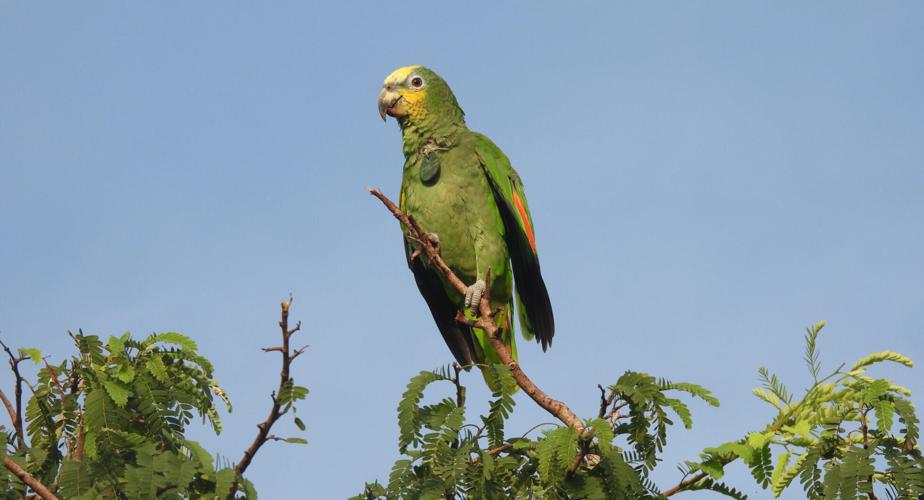
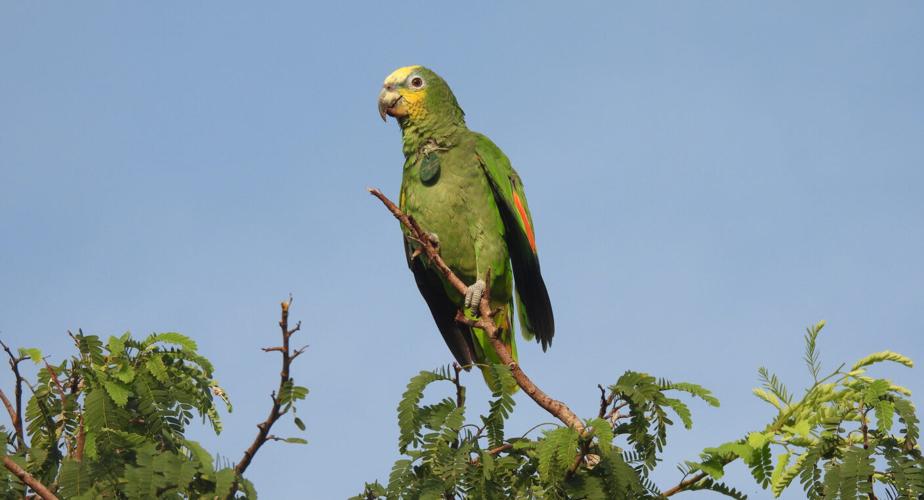
In a study recently published in Bird Conservation International, the research team found that confiscated yellow-crowned Amazon parrots trained using free-flight techniques showed strong survival, flock cohesion and site fidelity after release in Colombia, demonstrating the promise of the technique as a conservation tool.
“Every day, more animals are coming in to rescue centers, and they’re just piling up waiting to be released,” said Dr. Donald Brightsmith, an associate professor in VMBS’ Department of Veterinary Pathobiology and a researcher focused on parrot conservation. “What I want to try and do is find ways that more of these animals can be put back into the wild with a reasonable chance of success.”
Teaching birds to be wild
Traditional parrot rehabilitation and release programs often keep the birds in captivity until they are physically mature.
However, parrots are highly intelligent animals that learn many of their survival skills after leaving the nest. By the time they are released, many have spent months or even years developing behaviors that are useful in captivity but less helpful in the wild.
To address this challenge, BRI’s Chris Biro used free-flight training, a technique developed for companion birds that takes advantage of critical learning periods that correspond to the age when young parrots leave the nest.
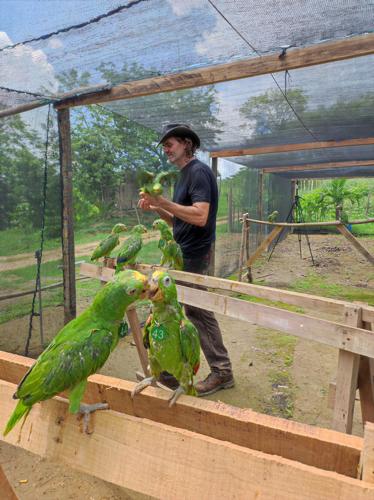
The birds in the study had been confiscated from the illegal wildlife trade as chicks and arrived at FL’s rehabilitation center around fledging age, when wild parrots naturally begin learning crucial survival skills.
The research team gradually trained the birds to fly longer distances by rewarding them with hand-feeding formula. As the parrots gained confidence, they were introduced to the outdoor environment, where they could begin exploring the landscape while still receiving support.
“If you put the animal in the right environment at the right age, they develop the skills that are needed for survival,” Brightsmith said.
This technique is particularly effective because, instead of teaching individual skills separately, it allows birds to learn many aspects of survival at once — including flying, navigating, recognizing food sources, responding to environmental cues and traveling in a flock.
Strong results after release
The study followed 18 yellow-crowned Amazons released at FL’s private reserve in Colombia.
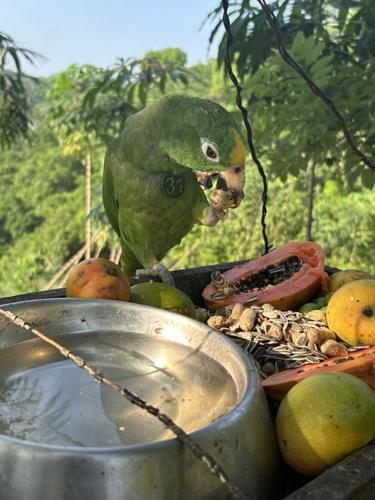
The field team, led by FL’s Alejandro Rigatuso, found that all 18 parrots used the supplemental feeding stations after release and showed strong flock cohesion, meaning they continued moving through the landscape as a group. Nearly all remained near the release site during the early months after release.
One month after release, 94% of the birds were still returning to the feeding stations. After three months, 89% remained, and after one year, 72% continued returning to the site, indicating that most successfully adapted to life in the wild while remaining near the release area.
According to Brightsmith, those social connections that stem from traveling and navigating the surrounding landscape together may play an important role in helping young birds survive.
“It’s safer to live and travel in a group,” he said. “Predators have more trouble taking animals out of groups than they do picking off individuals.”
Conservation beyond the aviary
The project’s success depended on more than the birds themselves.
Because the release site was located near local communities, FL paired the effort with school programs, community events, social media outreach and communication networks that encouraged residents to report sightings and avoid interacting with parrots.
“The most useful aspect was when local people reported back,” Brightsmith said. “We were able to go and get birds when they got into trouble.”
The importance of collaboration extends beyond individual release projects. To help connect researchers, veterinarians, rehabilitation centers and conservation organizations working on parrot releases across the Americas, Brightsmith founded the Parrot Release Network, a Texas A&M-led initiative that includes nearly 300 members.
“There’s a lot of things we don’t know about releasing parrots,” Brightsmith said. “Unfortunately, most rescue centers have been operating in a vacuum with few chances to share their successes and get advice from colleagues.”
Now, the Parrot Release Network provides a forum for sharing research findings, discussing challenges and exchanging practical advice, helping global parrot conservationists build on one another’s successes and failures.
A potential tool for conservation
For wildlife rehabilitation centers, the findings offer a possible path toward reducing the growing number of parrots that remain in long-term captivity.
Traditional rehabilitation programs often require years of housing, feeding and caring for birds before release.
“It’s a win-win if you can get these birds out quickly,” Brightsmith said.
The research team hopes to continue exploring how the approach can be adapted for other species, including smaller parrots and older birds that present additional rehabilitation challenges.
Ultimately, Brightsmith sees the work as part of a broader effort to restore wildlife populations while giving confiscated animals a second chance at life in the wild.
“This approach gives us the opportunity to establish new populations in places where parrots have disappeared,” Brightsmith said. “We can rewild the landscape by bringing them back into areas where they no longer exist.”


